 Antigua Guatemala City Guide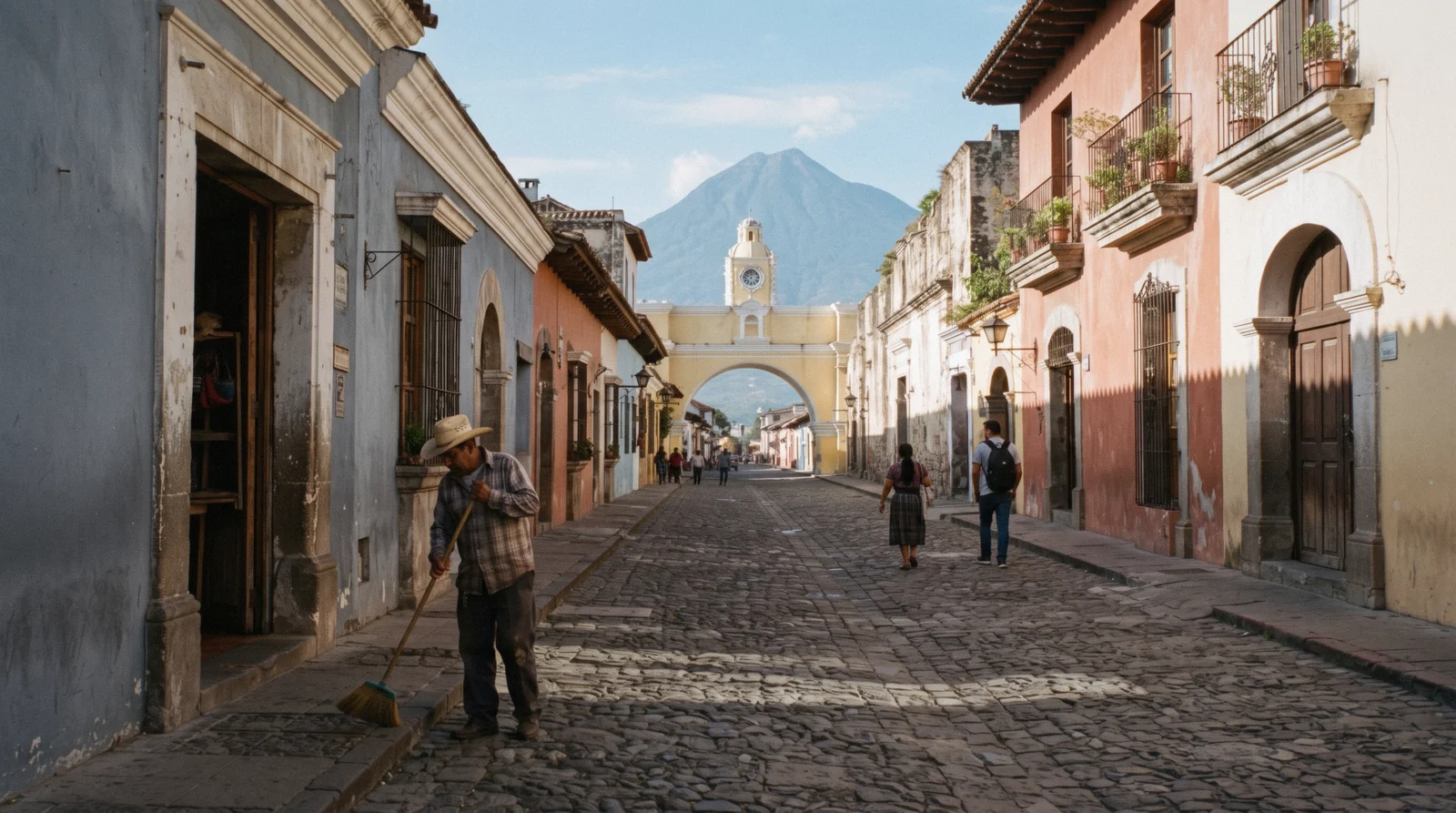
Antigua Guatemala Centro Histórico
Inscribed on the UNESCO list in 1979, the Antigua Guatemala Centro Histórico is the colonial grid where every sight on a first list sits 0-5 minutes on foot from the park, and this page in this Antigua Guatemala city guide decides whether you should base a visit inside that grid or on its quiet edges. We cover the street logic, the noise trade, the tuk-tuk reality, and a five-hour loop that strings the fixed points together.
Quick answer What the grid is, what a day costs, how you move
The Antigua Guatemala Centro Histórico is the UNESCO-listed colonial grid around Parque Central, inscribed in 1979, and every sight on a first list sits 0-5 minutes on foot. A licensed-guide walking loop at $25 fixes your bearings on day one, and after that the grid is free. Movement inside the grid is on foot, a tuk-tuk ride out costs a municipal Q10 ($1.31) if you agree it first, and the arch is the corridor you will cross most.
Key takeaways
- First visits sleep in the grid, quiet nights sleep west. The full argument runs through the six-area comparison, which treats the same ground without a ranking.
- The evening stays inside the grid if you plan it: rooftop drinks at Café Sky and craft beer at Cerveteca El Arco cover both ends of the night, and the decibel and closing rules are explained on the nightlife page.
- The second walking card covers the same streets from a different angle if the first loop fills, and the eats page handles dinner afterwards.
The Centro Histórico against the other five areas
This table lines the Centro Histórico up against the other five stay areas on walk minutes to the park, evening character, transport and who each suits. The walk figures are the street-geometry estimates used across this guide, not official figures, and they match the stay-areas page exactly.
| Area | Walk to Parque Central | Evenings | Transport reality | Best for |
|---|---|---|---|---|
| Centro (the colonial grid) | 0-5 minutes | The busiest sidewalks and the latest bar sound | No vehicle needed inside the grid, tuk-tuk out | First visits, short stays, evenings out |
| 5a/6a Avenida Sur and Alameda Santa Lucía | about 8-15 minutes (estimate) | Quiet, monastic walls | A short walk or one tuk-tuk | Calm nights, couples, Holy Week with a car |
| San Felipe | 30-40 minutes on foot (estimate) | Residential, streets empty early | Tuk-tuk is not optional after dark | Long stays, budget travellers |
| Jocotenango | 25-35 minutes on foot (estimate) | Courtyard calm, dinner back in town | Minutes by tuk-tuk, northbound buses pass through | Coffee and culture, families with a car |
| El Hato (the ridge above San Felipe) | 15 minutes by vehicle, then 300 m on foot | Views and hammocks, nothing after dinner | The last ride down decides the evening | A slow few days off the grid |
| Santa Ana | about 10-20 minutes on foot (estimate) | The quietest streets of the six | Walk back into the grid for dinner | Slow-travel couples |
Every area sits within 40 minutes of the park on foot and a tuk-tuk closes the gap for a municipal Q10 ($1.31). Figures current in Q3 2026.
Walk the Grid With a Guide
The grid explains itself faster with a licensed guide on the first morning than it ever will from a map. These are the two walking cards carried in this site's things-to-do guide, both small-group walks that start from fixed meeting points near the park.
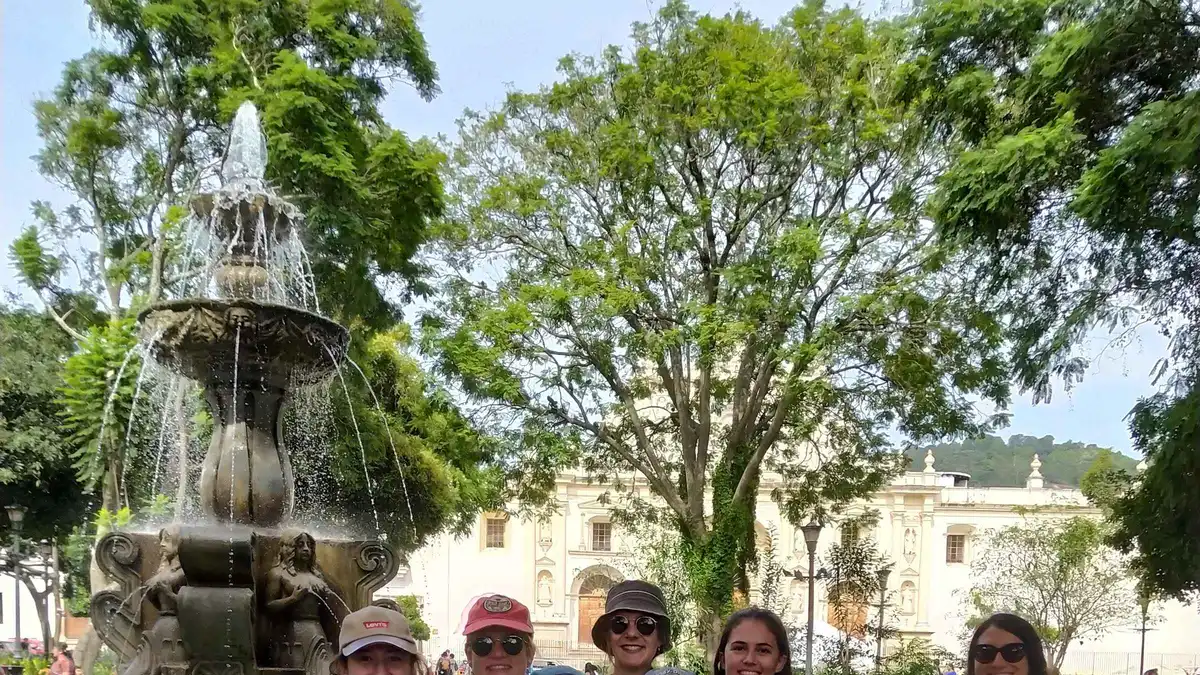 from $25
Antigua Guatemala: City Highlights Guided Walking Tour
2.5-hour small-group walk through the grid with a licensed guide; the fastest way to make the ruins and churches mean something.
Check Availability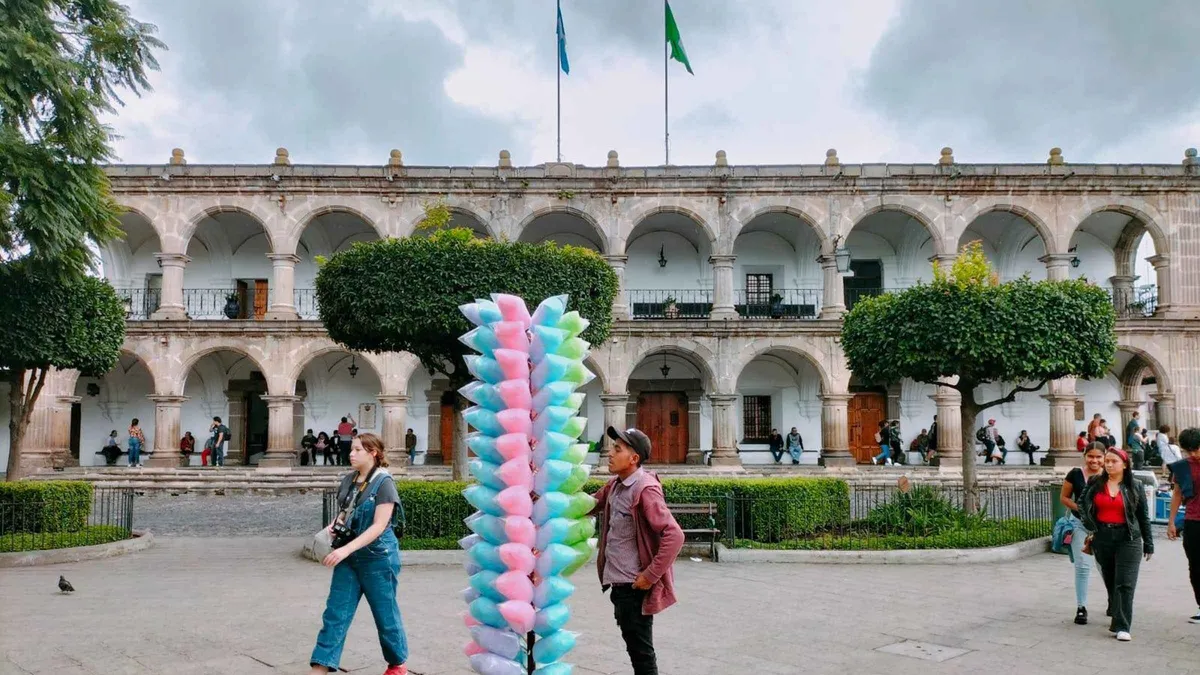 from $25
Antigua walking tour: Highlights, history, culture.
A cheaper 2.5-hour walking tour over the same ground as the top-rated one; fine if you just want orientation.
Check AvailabilityPrices, ratings and details are the platforms' own.
Prices, ratings and details are the platform's own. dollar figures are the listed prices — the platform bills in your account's currency.
How the Grid Reads, Street by Street
Once you understand the numbering, the whole Centro Histórico becomes a two-axis problem you can solve on foot.
The plan is a checkerboard, rebuilt on the same colonial footings after every earthquake. Avenidas run north-south and calles run east-west, numbered out from the centre. That centre is Parque Central, the zero point of every address in the city.
Avenidas Poniente sit west of the park and Avenidas Oriente east, same for the calles, so an address tells you the block before you take a step. Addresses repeat the street number, which is why you will read two houses called number 8 on the same calle, one on each side. The street to learn first is 5a Avenida Norte, popularly the Calle del Arco, because it is the city's most recognisable corridor.
The Santa Catalina arch spans it, begun in July 1693 so cloistered nuns could cross between convent buildings unseen, and every visitor photograph in town is taken underneath it. The texture is cobblestones and ruined convent walls, broken lintels left standing as garden features. The UNESCO World Heritage listing came in 1979 and covers this grid, and INGUAT recommends 3-4 days for the city, which is about right for the streets alone.
What a Morning Feels Like
Mornings in the grid reward early risers twice, once with the light and once with empty pavements.
The light comes late through the valley because the ridges hold the sun back past seven, so the streets stay cool and grey-gold while shopkeepers wash their doorways with buckets. By mid morning the park fills with school groups in uniform and the shade under the trees gets contested. Café Condesa serves its farm-to-table breakfast in the colonial mansion on the park itself, pouring pure Antigua coffee, and has done so since 1993.
Two blocks away, ChocoMuseo at 4a Calle Oriente 8 opens daily from 10am to 7pm, and its bean-to-bar workshops start from $30.00 (Q229.20) if you want to turn a morning into a skill. For maps and current advice the INGUAT tourist office sits at 5a Calle Oriente No. 11, phone (502) 2290-2800. The serious early move is uphill: the signposted trail to Cerro de la Cruz takes about 20-30 minutes from the historic centre, and from the cross you look straight down the grid's axis to Volcán de Agua.
Do it before ten and you get the view without the midday heat.
What an Evening Feels Like
Evenings in the Centro Histórico concentrate around two fixed points, a rooftop and a taproom, with a crêperie in between.
Café Sky at 1a Avenida Sur 15 runs its rooftop daily from 8am to 10pm, and its self-description as the city's iconic rooftop is close to fair, because the terrace looks across the roofs to Agua. At the other end of the evening scale, Cerveteca El Arco at 5a Avenida Norte 20A pours four house beers, a blonde, an amber, an IPA and a stout with a nitro version exclusive to the taproom, daily 10am to 11pm. It sits directly on the arch corridor, so your beer comes with the postcard through the window.
For dinner without ceremony, Luna de Miel on 6a Avenida Norte N40 is a French crêperie that takes no reservations and runs Sun-Thu 10:00-21:00 and Fri-Sat 10:00-22:00. Three municipal rules shape all of this: ambient music is capped at 60 decibels and permitted 06:00-23:00, and venues running after 20:00 need municipal authorization. Those come from secondary sources, marked as such, and the breakdown lives on nightlife.
If you want a table worth booking instead, the dinner rooms are listed on where to eat.
Noise: What the Walls Do Not Stop
The 0-5 minute address has a price, and the price is measured in decibels.
The trade for the central address is sound. Bar music carries until closing, and because the municipal window runs to 23:00, that can be later than light sleepers expect. The arch corridor keeps foot traffic well into the evening, and voices on cobblestones bounce upward into upper-floor rooms.
Fireworks go off for saints' days with no published schedule, so a 5am boom two streets away is possible on any given night. Church bells start early and are part of the deal, not a flaw to complain about. The fix is simple and it is the same advice the stay-areas page gives: one street back from the arch or the park changes the nights completely, turning the same address into a quiet one for the same walk minutes.
Practically, ask any hotel which way the room faces before you pay for it, and specifically ask whether it opens onto the arch corridor, a bar street or an interior courtyard. Stone walls stop a lot, but they do not stop a procession drum line.
Transport Reality: Feet, Then Tuk-Tuks
Inside the grid the transport answer is your shoes, and everything else starts at the edge.
Everything inside the grid is a 0-5 minute walk, so the transport question only starts when you leave it. Tuk-tuks are the vehicle that closes the gap. The municipal tariff is Q10 ($1.31) per ride inside the city, they are not metered, and they run on cash.
In practice drivers often ask visitors Q15 or more, which Wikivoyage describes as a routine 50-100% premium, so agree the fare before boarding, every time. Flag one in the street or use the taxi queue at Parque Central. They stop working around 22:00, which matters if you land late, so a late arrival needs a pre-booked transfer, and the options are costed on the airport page.
Chicken buses do not cross the grid at all, they leave from the terminal behind the market on the west side of town, and that is where the village and Guatemala City routes live, as covered on chicken buses. Cars inside the grid are a liability on cobbles, which is why the stay-areas page pushes Holy Week drivers to the Santa Inés end. The full picture, fares and all, lives on getting around.
Five Hours in the Grid, in Order
This loop strings the fixed points together at a walking pace, east to west and then uphill, with the one fact that decides each stop listed against it.
The order works because it moves east to west through the park blocks and ends on the hill, so the last leg doubles as the view. Entry fees for the ruined convents are not published online, so carry small cash in quetzales for the ticket windows. Casa Santo Domingo's museums can close early without notice, so do not promise yourself the full complex on a fixed schedule, and if the courtyard tempts you to stay, its hotel rooms start from $225.00 (Q1,719).
Start at the park at nine, finish on the cross by two, and eat after.
| Stop | Where | The fact that decides it |
|---|---|---|
| Parque Central and the Sirenas fountain | The zero point | The fountain was built by Diego de Porres in 1737, the plaza has been called Plaza Mayor, Plaza Real and Plaza de Armas |
| San José Cathedral | South side of the park | First built from 1545, the working parish occupies the rebuilt section and the rest stands in ruins (the cathedral) |
| Santa Catalina Arch | 5a Avenida Norte | Begun July 1693 for the nuns, restored in 2017, clock damage from the 1976 quake repaired in 1991 |
| La Merced | One block north of the arch corridor | Its Fountain of los Pescados is 27 m across, among Latin America's largest colonial fountains (La Merced) |
| Cerro de la Cruz | North edge, signposted trail | About 20-30 minutes up from the historic centre, the volcano postcard (the viewpoint) |
The Museums and the Ruins, and What They Actually Publish
The grid holds most of the city's museums and its famous ruined convents, and what each one publishes decides how you plan around it.
What is listed, and what is missing
The official tourist institute's museums list for the city names the Museo Nacional de Arte de Guatemala inside the Real Palacio de los Capitanes facing the park, the Museo del Libro Antiguo with books and documents printed in Guatemala between 1660 and 1821, the Museo de la Semana Santa in the cloister of Sor Juana de Maldonado, and the Museo de Arte Colonial on 5a calle oriente, alongside the six permanent museums and two galleries of Casa Santo Domingo. On entry, the institute's own wording is that in most cases you buy the ticket directly at the door.
Now the honest gap, because it changes your cash planning. Not one of the famous ruined convents publishes a fee online. Capuchinas is owned by the Consejo Nacional para la Protección de La Antigua Guatemala and access is paid, but no tariff is printed on any official page, and fees reportedly differ for nationals and foreigners. Santa Clara is listed by the institute with no practical data at all, and the Consejo has no reachable website. Casa Santo Domingo's museum price appears nowhere on its own site either, which says to contact the concierge at (502) 7820-1220. Carry small notes in quetzales and expect the ticket window to be the only place a figure exists. The same institute's cave is worth repeating: Casa Santo Domingo's museums may close before the scheduled time without prior notice.
The ruin entry in the full tickets picture collects what the city does publish.
| Site | What is published | What is not |
|---|---|---|
| Casa Santo Domingo museums | Hours Mon-Sat 9:00-18:00, Sun from 11:00, six museums plus two galleries | Entry price, anywhere online |
| Convento de las Capuchinas | CNPAG ownership, paid access, the 18th-century circular cell courtyard | Fee amount, opening hours, closed days |
| San José Cathedral ruins | The 1545 first build, Alvarado reinterred December 2007, crypts and tunnels | Entry price for the ruined sections, hours |
| Cerro de la Cruz | The signposted trail, about 20-30 minutes from the historic centre | Fee, opening hours, any official shuttle |
Shopping the Grid: Jade, Textiles and Sweets
The blocks between the park and the arch carry most of the city's verifiable shops, and their hours are the reliable part.
Jade runs the strongest thread. Jade Maya, the original Maya jade showroom and museum founded in 1974 by the archaeologist Mary Lou Ridinger, keeps its headquarters at 4 Calle Oriente 34, daily 9am to 6pm, with the Pakal store at 3 Calle Oriente 1 and the Aguateca store on 5a Avenida Norte 9 on Arch Street, which closes at 6:30pm Monday to Thursday and 8pm on Fridays through Sundays. Casa del Jade at 4a Calle Oriente 10 in the El Jaulón building runs a shop, a small Mesoamerican jade museum and a two-hour workshop where you carve your own piece. Entry prices are not stated at either operation.
Textiles concentrate at Nim Po't, 5a Avenida Norte 29, right by the arch, which sells handwoven huipiles, masks, pottery and blown glass on a backstrap-loom tradition, though its own site states no opening hours. For sweets, the official institute's article on the city's typical dulces names two houses, Doña María Gordillo with recipes since 1872 and El Convento Dulcería on Calle de Los Pasos. The famous handicrafts market at El Carmen is a gap in our own coverage, no citable source published its details this year, so treat anything specific you read about it with the same suspicion we do. The wider buying guide lives on shopping.
When the Grid Closes: the Holy Week Machine
For one week of the year the streets you are choosing between become the procession network, and the municipality runs them on its own rules.
On procession Sundays and on Holy Thursday and Friday the municipality pushes vehicles out of the affected streets with a perimeter that activates at 4:00 a.m. Palm-Sunday closures in one recent season included Calzada Santa Lucía, Calle Ancha and Desengaño. Parking migrates to the lots at Santa Inés and La Pólvora, where the MarbEx vehicle sticker runs Q10 on weekdays and Q20 on Fridays, weekends and the season itself, with motorcycles and buses at their own tiers, and free shuttle buses run from the lots into town. From Holy Thursday through Easter Sunday, shops and deliveries resupply only in the small hours before 4:00 a.m.
Two caveats belong beside those facts. They are one season's operating pattern, published through a secondary portal that reproduces the municipality's plan, and the programación for the next Easter had not been published at our last check. And the scale is real: one season counted about 56 velaciones and 58 processions across the city. Read it as a street-choice problem rather than a spectacle problem. Sleep on a procession route only if the processions are the reason you came, because from dawn the carpets, the incense and the crowds are a wall. Everyone else should pick a street one block off and treat the routes as an excursion. The routes in detail are on Semana Santa, and the bed-side argument is on where to stay.
The Centro Histórico on the Map
The carmine pins are the fixed points of the grid, with coordinates taken from Wikidata and official pages. The two green pins are the hill above the grid and the monastery on its eastern edge, and every pin note carries the fact that decides whether to walk there.
Beyond the Grid
San Felipe
The residential south-west on the old Ciudad Vieja road, 30-40 minutes out and a different city: San Felipe.
30-40 min walkJocotenango
The finca town over the north-west line, coffee museum and courtyard restaurants: Jocotenango.
25-35 min walkWhere to stay
All six areas argued as ground, not rankings, with the one published rate: where to stay.
The money questionCentro Histórico: Questions
What is the Centro Histórico in Antigua Guatemala?
It is the UNESCO-listed colonial grid of the city, inscribed in 1979, built as a checkerboard of avenidas and calles around Parque Central. In practice it is the stretch between the arch corridor and San Francisco, where every sight sits 0-5 minutes on foot and the sidewalks carry most of the city's evening traffic.
Do you need a car in the Centro Histórico?
No. Everything inside the grid is a 0-5 minute walk, cars are a liability on cobblestones, and the procession streets close to vehicles during Holy Week. If you arrive with one, park it at the edge and walk. The practicalities are on getting around.
How many days do you need for the Centro Histórico?
INGUAT recommends 3-4 days for the city, and the grid holds two of them well, a walking loop plus the museums and the hill. The rest of a longer stay belongs to day trips. The full menu is on things to do.
Is the Centro Histórico noisy at night?
The arch and park corners are. Bar sound and foot traffic run late, fireworks go off for saints' days with no published schedule, and church bells start early. One street back changes the nights completely. Secondary-sourced municipal rules cap ambient music at 60 decibels and allow it 06:00-23:00.
How much does a tuk-tuk cost from the Centro Histórico?
The municipal tariff is Q10 ($1.31) per ride within the city, cash, not metered. Practice often runs higher for visitors, so agree the fare before boarding. Tuk-tuks stop working about 22:00, so later trips need a pre-booked transfer. More on getting around.
What does a day in the Centro Histórico cost?
Walking the grid is free. The guided walking loop is $25, a ChocoMuseo workshop starts from $20.00 (Q152.80), and entry fees for the ruined convents are not published online, so carry small cash. A worked daily budget sits on the costs page.
Where do I park for the Centro Histórico?
The municipality publishes its car-park plan for the procession season, with the lots at Santa Inés and La Pólvora among them, but no comparable official map exists for the rest of the year, so the practical answer is to leave the car where your hotel says and walk. Cars inside the grid are a liability on cobbles anyway, and the Holy Week machinery is described in the closure section.
Prices, hours and terms are set by the venue or operator and confirmed at checkout.
We may earn a commission if you book through one of our links, at no extra cost to you. Full affiliate disclosure