 Antigua Guatemala City Guide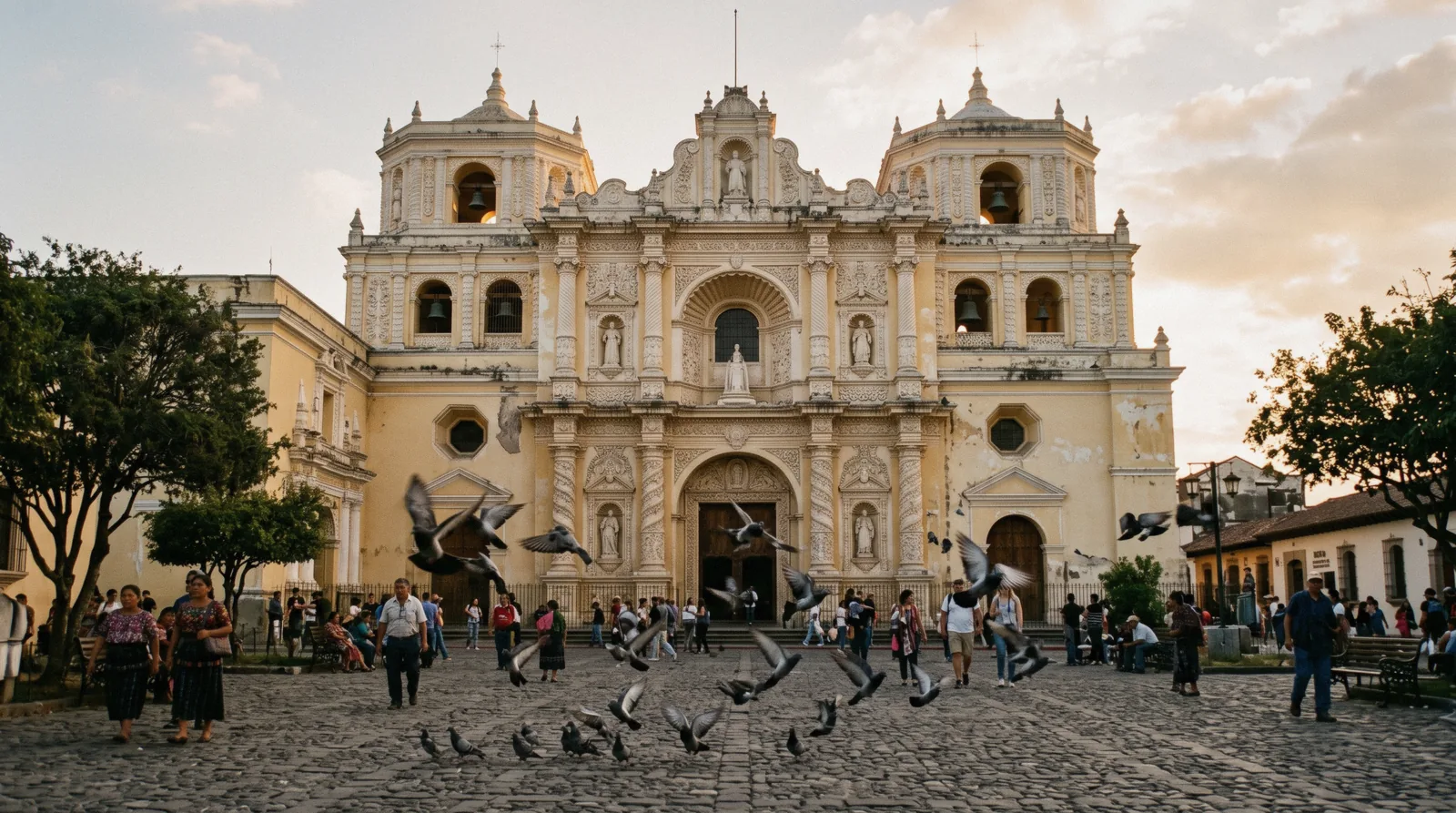
La Merced Church
La Merced church Antigua is the yellow baroque landmark two blocks north of the Santa Catalina Arch, and it is the stop that explains the whole city. Built between 1749 and 1767, it shrugged off the 1773 earthquakes that broke the rest of the colonial capital, and it went on to launch the two great Holy Week processions Antigua is famous for. Entry to the church itself carries no published fee. For a small reported charge you can climb the convento rooftop for the best city-and-volcano panorama in the grid. If you want the story unpacked as you walk, a city highlights walking tour covers La Merced among the essentials, and our Antigua Guatemala city guide pulls the rest of the trip together.
Quick answer Cost, rooftop, style, Holy Week
La Merced is the yellow Churrigueresque church two blocks north of the Santa Catalina Arch. Construction ran from 1749 to 1767 under the architect Juan de Dios Estrada, and the church was dedicated in 1767. Because it was practically new, it took no major damage in the 1773 Santa Marta earthquakes and stayed open for worship while the rest of the capital emptied out. Entry to the church itself has no published fee, since no parish website or official tariff exists anywhere. The convento rooftop is reported at Q10 for nationals and Q35 for foreigners, which is $1.31 (Q10) and $4.58 (Q35), and it is reported open daily from 9:30 to 20:00 by Qué Pasa magazine. The church is the birthplace of Antigua's two great Holy Week processions, the Palm Sunday route and the Good Friday Procession of Penance.
Key takeaways
- Plan 20-30 minutes for the nave plus about an hour if you add the rooftop and the fountain, and let a city walking tour frame the history for you.
- The only published money fact is the rooftop fee, reported by Qué Pasa magazine. Compare it line by line in the cost table.
- Come in Holy Week only if you want crowds and spectacle. The processions that start here are covered in our Semana Santa guide.
Key facts
Opening hours
| Church | Hours not stated by any official source, no parish website exists. Daylight visits are the practical window |
|---|---|
| Convento rooftop (reported) | Daily 9:30-20:00 (Qué Pasa magazine, secondary) |
Closed None stated, the church has no published closing days. Expect access limits around Holy Week services
Admission
- Adult
- Church entry: no fee is stated by any official source (no parish site exists). Convento rooftop/museum: reported Q10 nationals / Q35 foreigners ($4.58 (Q35)), Qué Pasa magazine, secondary. The former convent's museum hours and price are otherwise not stated
Planning it
- Time needed
- 20-30 minutes for the church, about an hour if you climb the rooftop and circle the fountain
- Book ahead
- Optional — walk-up usually fine
- Address
- North of the Santa Catalina Arch corridor, a short walk from Parque Central, no postal address is published by any official source. The GPS below is exact (Wikidata)
What a visit costs
The church nave costs nothing to enter, because no official source anywhere states a fee. The only money figure in play is the rooftop, reported at Q10 for nationals and Q35 for foreigners by Qué Pasa magazine, a secondary source. If you would rather have the history explained as you go, the city walking tours below cover La Merced for $25.
Are you walking the free church floor, or paying the small reported fee for the rooftop over the city?
| Option | Price | Includes | Fine print | Cancel | Book |
|---|---|---|---|---|---|
| Church entry, the naveAnyone visiting the nave at street level, the church floor costs nothing official | The baroque nave, the altar and the facade at street level | No fee is stated by any official source, no parish website exists. Donation practice is on-site | Not applicable | Official site | |
| Convento rooftop and museum, reportedVisitors who want the city-and-volcano view over the rooftops, the only priced part of the site | Q10 nationals / Q35 foreigners ($4.58 (Q35)) | Rooftop city-and-volcano views via the convento to the left of the church | Source is Qué Pasa magazine (secondary), hours 9:30-20:00 daily as reported. Official confirmation does not exist online | Not stated | Official site |
The church itself publishes no tariff anywhere. The rooftop figure is Qué Pasa's report, not an official one, and the museum's own hours and price are not stated online. Read in Q3 2026.
Guided context for the church
There is no La Merced-only ticket, so we will not pretend otherwise. What exists are city walking tours that cover La Merced among the highlights, and both of these do exactly that at the same $25 price. If you like a guide to explain the baroque, the earthquakes and the processions while you stand in front of them, book one of these first and revisit the church on your own afterwards.
 from $25
Antigua Guatemala: City Highlights Guided Walking Tour
2.5-hour small-group walk through the grid with a licensed guide; the fastest way to make the ruins and churches mean something.
Check Availability from $25
Antigua walking tour: Highlights, history, culture.
A cheaper 2.5-hour walking tour over the same ground as the top-rated one; fine if you just want orientation.
Check AvailabilityPrices, ratings and details are the platform's own. dollar figures are the listed prices — the platform bills in your account's currency.
What La Merced is, and why it is yellow
La Merced is the most photogenic church in Antigua, and its colour is the reason half the city's postcards look the way they do.
The Iglesia de La Merced stands north of the Santa Catalina Arch corridor, a couple of minutes on foot from the arch and a short walk from Parque Central. It is a Mercedarian church and convent complex, and the church is the working building while the former convent holds the museum and the great fountain. GPS 14.56167, -90.73435 puts you at the door.
Architecturally, the facade is Guatemalan Churrigueresque, the local branch of what is also called Spanish seismic baroque. In plain terms, that means exuberant carved decoration wrapped around a structure engineered to survive earthquakes, with two bell towers flanking a facade built from sturdy local materials rather than the fragile ornament-heavy stone you would see in Spain. On the upper facade stands St. Peter Nolasco, founder of the Mercedarian order, watching over the street.
As for the yellow, the honest answer is simple. The yellow and cream stucco is how the church presents today, and it is what every photograph of the building shows. The sources do not give a restoration date or a documented explanation for the current paint scheme, so we will not invent one.
Come at golden hour, stand across the square, and you will understand why this facade is the most photographed in the city. Our Antigua Guatemala city guide lists the best light for it.
The church the 1773 earthquakes spared
Every other great religious house in Antigua carries visible scars. La Merced does not, and the reason is luck of timing.
Construction began in 1749 under the architect Juan de Dios Estrada, and the church was dedicated in 1767. When the Santa Marta earthquakes struck in 1773, the building was practically new. Its structure had not been weakened by earlier shocks, and it suffered no major damage while the cathedral, the monasteries and hundreds of colonial houses around it crumbled.
The engineering explains a lot of it. The walls are famously thick, about 15 feet by Qué Pasa's measurement, pierced with small windows. That is the essence of earthquake-resistant baroque, mass and few openings instead of height and glass.
The building was designed to sway and hold, and it did. Because it survived intact, it remained open for worship after the 1773 disaster, even as the capital was ordered moved to what is now Guatemala City. That continuity mattered.
When the religious life of the old capital regrouped around the churches that still stood, La Merced was one of the strongest of them, and that is how a practically new church became the processional heart of the city, the place where the Palm Sunday and Good Friday traditions that define Antigua today took root.
La Merced in dated lines
-
1536
The Mercedarian order arrives
The order reached the previous capital of Guatemala, per Qué Pasa magazine (secondary).
-
1543
Relocation to Antigua
The Mercedarians moved with the capital to what is now Antigua, per Qué Pasa magazine (secondary).
-
1650
The Jesús Nazareno is carved
Alonso de la Paz carved the image in cedar with plaster, glass eyes and real hair, per Qué Pasa magazine (secondary).
-
1704
The main altar is gilded
The high altar received its gold leaf, per Qué Pasa magazine (secondary).
-
1749
Construction begins
Work starts under the architect Juan de Dios Estrada (Wikipedia, facts pack). An infobox variant gives 1751.
-
1767
The church is dedicated
After nearly two decades of building, the church enters service (Wikipedia, facts pack).
-
1773
The Santa Marta earthquakes
Practically new, the church takes no major damage and stays open for worship while the capital is lost (Wikipedia, facts pack).
-
19th century
Quarry and repair
The monastery serves as a stone quarry. The church is repaired between 1850 and 1855 and has been open since, per Qué Pasa magazine (secondary).
-
Today
The rooftop
The convento rooftop is reported open daily 9:30-20:00 with admission of Q10 nationals and Q35 foreigners, per Qué Pasa magazine (secondary). No official online confirmation exists.
Dates from 1749 to 1773 come from the checked Wikipedia-based facts pack. All other entries rely on Qué Pasa magazine, a secondary source, and are flagged as such.
The convento rooftop
This is the best paid view in Antigua, and the honest sourcing story matters as much as the view.
You do not enter through the church. Access is through the monastery, the convento, to the LEFT of the church facade. Qué Pasa magazine reports that the rooftop is open daily from 9:30 to 20:00, with admission of Q10 for Guatemalan nationals and Q35 for foreigners, which is $1.31 (Q10) and $4.58 (Q35).
That is four dollars and change for the single most quoted view of the city. What you get up there is the colonial grid laid out under you, red tile roofs running straight to the base of Volcán de Agua. From the bell towers' level you can pick out the arch corridor, the cathedral roofline and the hills around the valley.
Bring small coins, because the reported tariff is paid on site and there is no online booking of any kind. Now the honest gap. There is no official tariff and no official hours published anywhere online.
The former convent's museum has no official web presence at all, so both its hours and its price must be confirmed on the door. Qué Pasa is a reputable local magazine, but it is a secondary source, and we label it as one every time we cite it. If you would rather not pay at all, the Cerro de la Cruz viewpoint gives you a free city panorama from the hillside, reached on a signposted trail that takes about 20-30 minutes from the historic center.
The 27-metre fountain
Behind the church, inside the convento, sits one of the largest colonial fountains in Latin America.
The Fountain of los Pescados, the fountain of the fish, dates from the 18th century and measures 27 metres in diameter. Sources rank it among the largest colonial fountains on the continent, and standing at its rim you believe it. It was built to serve the monastery's gardens, a working piece of hydraulic engineering dressed up as a monument.
You see it as part of the convento visit, the same route that leads you to the rooftop. Enter through the convento to the left of the church, and the fountain anchors the courtyard before you climb. It photographs best from the corners where the arcades frame it, and it is one of the few sights in Antigua that most visitors walk past without realising the scale.
Circle it slowly. The reported rooftop fee of $4.58 (Q35) buys you both the fountain and the view.
La Merced and Holy Week
If you know Antigua only through images of processions and street carpets, you already know La Merced without realising it.
Two of the city's major Holy Week processions were born here, the Palm Sunday procession and the Good Friday Procession of Penance. This is the church where Antigua's most famous tradition took shape, and on Palm Sunday the processions still leave from its doors. The image at the centre of that devotion is the Jesús Nazareno, carved in cedar by Alonso de la Paz in 1650, with plaster, glass eyes and real hair, per Qué Pasa magazine.
It is the sculptural heart of the processions that move through these streets each Easter week. Know what you are walking into if you come for it. The city fills and logistics tighten across Holy Week, and the arch and cathedral area as well as the La Merced routes see closures and heavy crowds while carpets and processions take the streets.
Our Semana Santa guide covers the routes, the timing and the practicalities in detail. If your trip is not built around processions, visit the church early in the week or outside the season entirely.
Five things most visitors do not know
Small facts that change how you look at the building.
The list
- It survived 1773 not through luck alone but because it was practically new, its structure untested and unweakened by earlier quakes, so the Santa Marta earthquakes left it open for worship while the capital fell around it [facts pack, Wikipedia-verified].
- Sixteen large ceramic lions, made locally, stand around the base of the exterior dome [Qué Pasa magazine, secondary].
- The church is a stop on the Brother Pedro Route, tying it to the pilgrim trail that runs through the city to San Francisco [facts pack, Wikipedia-verified].
- The main altar was gilded all the way back in 1704, decades before the current church building was even dedicated [Qué Pasa magazine, secondary].
- The museum in the former convent has no official online presence at all, so its hours and its price are on-site facts you confirm at the door, not online ones [facts pack, not stated].
Do and don't at La Merced
Do
- Go early in the day, when the square is quiet and the light is low on the facade.
- Carry Q35 in coins so the reported rooftop fee ($4.58 (Q35)) is not a problem at the convento door.
- Check the service schedule posted on the church door before you plan your visit, since no hours are published online.
- Walk from the Santa Catalina Arch, it takes about two minutes up the same street.
- Pair the visit with the arch and Parque Central, which sit within a five-minute walk and make one clean loop of the old city.
Don't
- Don't expect official opening hours, because none are published anywhere and no parish website exists.
- Don't attempt the rooftop during Holy Week processions, when the convento route and the street outside are packed.
- Don't photograph worshippers during mass, treat the nave as a working church first and a landmark second.
- Don't trust third-party ticket pages for La Merced, no official ticketing exists online for the church or the rooftop.
- Don't drive here, parking near the church is scarce. Walk, or take a tuk-tuk at the municipal tariff of Q10 = $1.31 (Q10) per in-town ride, paid in cash and not metered, and agree the fare before you get in because drivers often ask visitors more.
La Merced map: the church and the arch corridor
What to pair with La Merced
The church sits at the top of the old city's main corridor, so everything worth pairing is within a short walk. Build the loop in an afternoon.
Santa Catalina Arch
Walk two blocks down 5a Avenida Norte and you are under the Santa Catalina Arch, the most recognisable frame in the city. Shoot the arch with Agua behind it, then walk back up to the church.
2 min walkSan José Cathedral
The cathedral is the other half of the story, the great church the 1773 earthquakes broke while La Merced stood. Seeing both makes the survival logic obvious.
in townCerro de la Cruz
The Cerro de la Cruz viewpoint gives you the whole grid from the hillside on a signposted trail of about 20-30 minutes from the historic center, and no official source states any entry fee.
free, uphillMunicipal market
The municipal market sits a short walk west, where the chicken buses from Guatemala City also drop off. INGUAT's official page points visitors to the city's artisan markets for textiles, jade, ceramics and coffee.
short walk westLa Merced questions
Is La Merced church free to enter?
No official source states any entry fee for the church, and no parish website exists to publish one. Donation practice is on-site. The one priced element is the convento rooftop, reported by Qué Pasa magazine at Q10 for nationals and Q35 for foreigners ($1.31 (Q10) / $4.58 (Q35)), a secondary source.
What style was the church of La Merced built in?
Guatemalan Churrigueresque, the local form of what is also called Spanish seismic baroque. Construction began in 1749 under the architect Juan de Dios Estrada and the church was dedicated in 1767. The facade carries two bell towers and a figure of St. Peter Nolasco on the upper level.
What color is the Merced church?
Yellow and cream stucco, as the building presents today. It is the most photographed facade in Antigua. The checked sources document the building's structure and dates but give no restoration date or documented history for the current paint scheme.
Is the La Merced rooftop worth it?
At the reported price of $4.58 (Q35) for foreigners, the rooftop gives you the colonial grid and Volcán de Agua from above, which is the best paid view in the city. The caveat is sourcing. The hours (daily 9:30-20:00) and the price come from Qué Pasa magazine, a secondary source, and no official tariff or schedule exists online, so confirm on the door.
What time is mass at La Merced?
Mass times are not stated by any official source. The church has no parish website, and neither INGUAT's official page nor any checked reference publishes a service schedule. Check the notices posted at the church door on the day you visit.
Why are there so many churches in Antigua?
Because Antigua was the Spanish colonial capital until the Santa Marta earthquakes of 1773 forced the capital's move. Every major religious order built a convent and church here in that era, and the ruins and survivors you walk past today, La Merced included, date from that capital period. The city's density of churches is the footprint of a lost capital.
La Merced on film
Three videos that show the church, the convento and the processions before you arrive.
Convento e Iglesia de la Merced, Antigua Guatemala
A calm pass through the church and convento.
Video: Henrry FigueroaLa Esperanza de María- Procesión Jesús de la Merced, Antigua Guatemala, Domingo de Ramos 2025
The Palm Sunday procession leaving the church, the tradition this page describes.
Video: Sublimes Notas De DevociónIglesia de la Merced - Antigua, Guatemala 🇬🇹
A short exterior-and-facade visit.
Video: LandmarkVideos load from YouTube only when you press play.
Where La Merced fits in a day
La Merced rewards a morning slot, and it earns a second visit if you time it right.
Start your day here before the tour groups arrive. Walk up from the Santa Catalina Arch while the street is quiet, take the church in twenty minutes, then do the rooftop before the midday heat builds and the square fills. The reported rooftop hours run to 20:00 daily, per Qué Pasa magazine, so you have a long window, but the morning is when the facade light and the calm are best.
After the church, drift down the corridor through the arch to Parque Central and let the rest of the old city unfold from there. In Holy Week the calculation flips. You come to La Merced for the processions, not in spite of them.
The Palm Sunday route and the Good Friday Procession of Penance both trace back to this church, and the streets around it become the spectacle itself. Expect the city to be full and logistics to be tight, and plan meals and transport well ahead. For how this stop connects with the arch, the cathedral, the viewpoints and the market in one workable plan, see our Antigua Guatemala city guide.
Prices, hours and terms are set by the venue or operator and confirmed at checkout.
We may earn a commission if you book through one of our links, at no extra cost to you. Full affiliate disclosure