 Antigua Guatemala City Guide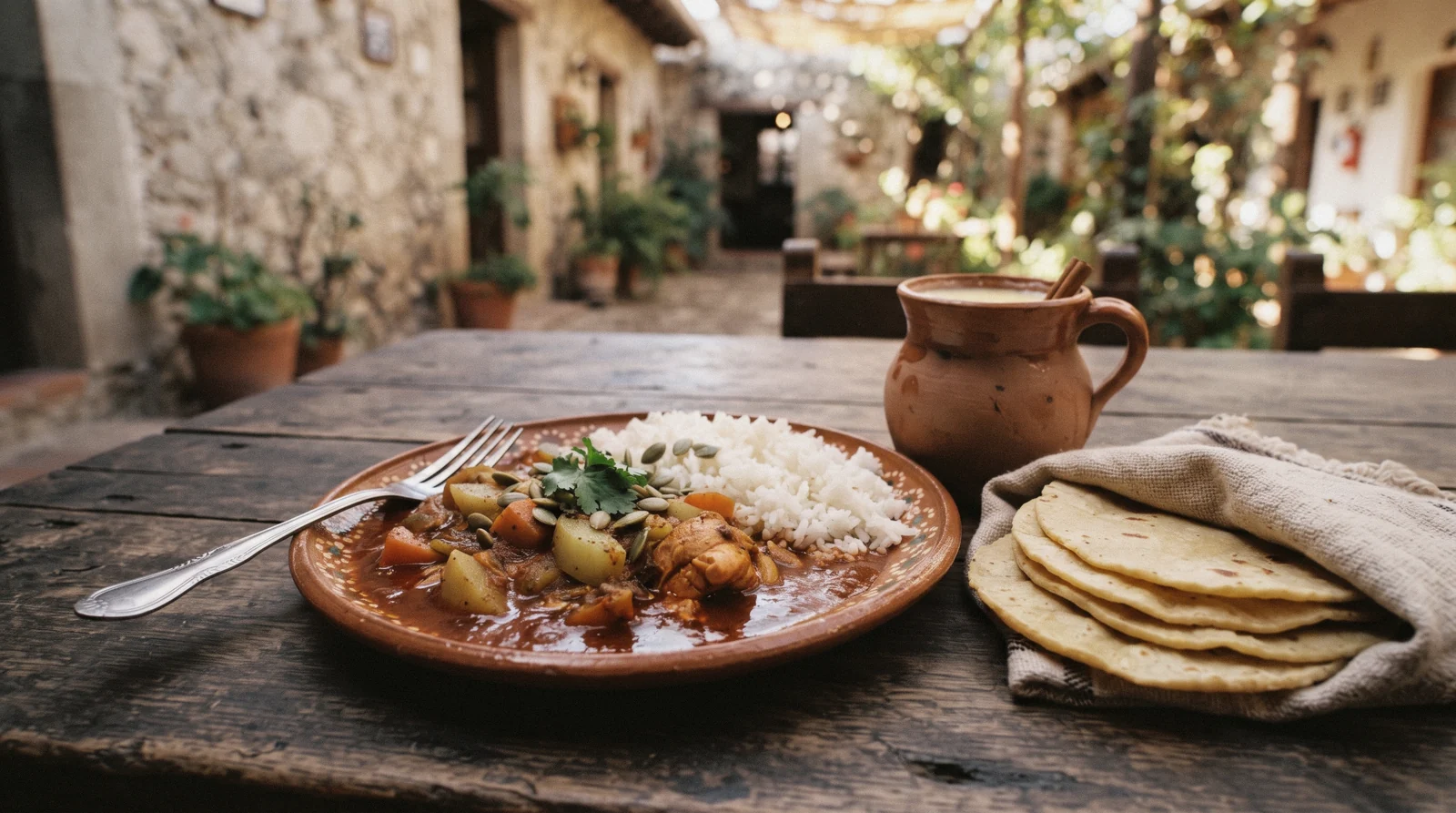
What to Eat in Antigua Guatemala
Deciding what to eat in Antigua Guatemala is easier than the food blogs make it sound. The country's own tourism institute names one dish as the city's typical plate, the culture ministry keeps a heritage registry you can actually read, and a handful of kitchens you can verify serve Guatemalan food in citable rooms. This page sorts the documented from the folklore, then points you at the full dining list and the two cooking classes that let you cook the dishes yourself.
Quick answer The dish INGUAT names, the registry that exists, where to eat it, what a class costs
What to eat in Antigua Guatemala starts with pepián, the stew INGUAT's own city page names as the typical dish, a traditional guiso combining Maya and Spanish influences. The verifiable kitchens serving Guatemalan food are El Maízal and La Azotea Carbón at Finca La Azotea and the Casa Santo Domingo dining rooms. The sweet shops INGUAT names are Doña María Gordillo (since 1872) and El Convento Dulcería. The fastest way in is a cooking class at $38.
Key takeaways
- Pepián is the dish INGUAT names, in its own words a traditional stew full of flavour combining Maya and Spanish influences. The UNESCO claim you will see repeated online could not be verified on any official page this check. The honest read is in the pepián section.
- The citable Guatemalan kitchens are El Maízal and La Azotea Carbón at Finca La Azotea in Jocotenango, plus the Casa Santo Domingo fine-dining rooms. Where to eat them, and the full dining list for everything else.
- Two cooking classes both cost $38. The Chef Farfán class runs three hours and is rated 4.9 from 177 reviews. Casa San Miguel is the pickup option with the shorter session, compared here.
- Finish at the dulcerías INGUAT names: Doña María Gordillo, making sweets since 1872, and El Convento Dulcería on the Calle de Los Pasos. The sweets section, with the market itself for context.
Pepián: The Dish Antigua's Own Page Names
What the official source actually says
INGUAT, Guatemala's tourism institute, keeps an official page for Antigua Guatemala, and that page names a single typical dish. The wording is worth reading as printed: el pepián, un guiso tradicional lleno de sabor que combina influencias mayas y españolas. In English, a traditional stew full of flavour that combines Maya and Spanish influences.
That is the whole official description. It tells you the dish is a stew, that it sits at the meeting point of two food traditions, and that the national tourism body considers it the plate this city is known for. It does not give an ingredient list, a recipe or a restaurant, and neither will this page, because no ingredient claim here could be sourced.
Separating the paper from the folklore
This guide treats food claims the way it treats every other claim: something is true if a citable source says it, and everything else is labelled as what it is. For pepián the citable source is INGUAT's city page, and it is strong enough to carry the headline. What sits beyond the paper is the layer of stories you will hear and read: that the dish has a particular ceremonial role, that one family's recipe is the original, that a specific market stall is the definitive version.
None of that could be verified against an official source this check, so none of it is repeated here. The dish is real and named. The legends around it are yours to test at the table.
The UNESCO claim, stated honestly
You will see the phrase UNESCO-recognized attached to pepián and to Guatemalan cuisine generally across travel sites. Be careful with it. No UNESCO listing of pepián or of Guatemalan cuisine could be verified this check, and UNESCO's own database of intangible heritage was not reachable on the attempts made here.
Until someone can point to an entry, treat any UNESCO claim about pepián as folklore, not fact. The checkable paper is Guatemalan and national: a ministry registry, described on this page under the heritage section, with hundreds of declared gastronomy elements. That registry is real and quotable.
A UNESCO inscription for the stew is not, and an independent guide should not pretend otherwise.
Ordering it in the city
What the INGUAT wording gives you at the table is a test. A pepián set in front of you should read as a stew, rich and full of flavour, the kind of plate where the Maya and Spanish meeting the page describes is visible in the sauce rather than the garnish. The cited kitchens that cook Guatemalan food are on the cards above, and the honest expectation to carry is theirs, not the blogs': a menu that changes with the market, and a kitchen that publishes no prices, no photographs and no promises.
Order it the way locals do, as the plate of the day rather than a performance of heritage.
The Heritage Paper That Actually Exists
SICULTURA and the 316 declared dishes
Guatemala's Ministry of Culture and Sports runs SICULTURA, the country's official cultural-information system, and SICULTURA maintains the national registry of declared intangible heritage. Its Gastronomía category holds 316 declared elements. The registry displays examples including Chatate en Pinol, Tamalito Dulce de Camotán, Atol Shuco and Chuchitos.
That is the document trail: a national ministry, a public registry, a counted category. When you want to tell someone at dinner that Guatemalan food is officially protected heritage, this is the citation that survives scrutiny, not a second-hand UNESCO claim.
Kak'ik, jocon and rellenitos: named, but not described
Kak'ik, jocon and rellenitos are plates travellers ask about constantly, and this page is deliberately careful with all three. No sourced description of any of them was verifiable this check, so each gets the same honesty: the names are real and asked about, the details are not stated here. Kak'ik is a particular trap.
Press summaries report a ministerial declaration for the dish, but secondary sources give two conflicting ministerial acuerdo numbers, and the documents themselves were not readable this check. So no acuerdo number appears on this page. A number printed wrong is worse than no number printed at all.
Fiambre and the Day of the Dead table
Fiambre is Guatemala's Day of the Dead plate, served around November 1-2, though no official page we could reach documents it. That is the full claim this page makes: a calendar context, tied to the Day of the Dead table in early November, with the honest mark attached. If you are in the city around those dates you may well encounter it at family tables.
What it contains, where it originated and which declarations it holds are not stated, because nothing citable could be fetched. The pattern repeats deliberately across this page: a named dish, a dated context, and no invented detail filling the gap.
The Dish List, Printed Honestly
Every plate a food-focused visitor asks about, with the exact status of its paperwork this check. It is a short table because honesty is short.
| Dish | Status this check | Source |
|---|---|---|
| Pepián | Named the city's typical dish, a stew combining Maya and Spanish influences | INGUAT city page |
| Chuchitos, Atol Shuco and other examples | Listed among 316 declared gastronomy elements | SICULTURA registry |
| Kak'ik | Ministerial declaration reported with two conflicting acuerdo numbers. No number printed | Press, conflicting |
| Jocón | Not stated | No citable source fetched |
| Rellenitos | Not stated | No citable source fetched |
| Fiambre | Calendar context only, tied to the Day of the Dead table around November 1-2 | Honest mark, no official page |
The table is the page's spine. Where a row says not stated, that is the finding: the plate circulates in blogs without a document behind it, and an independent guide does not convert a rumour into a fact by repeating it. Order the named dish where the kitchens above cook Guatemalan food, and treat the rest as discoveries of the table rather than promises of a menu.
Where To Eat Guatemalan Food In Antigua Guatemala
Every card below is sourced to the venue's own website or to an official INGUAT listing, checked directly. Where a venue's own site omits something, the gap is printed rather than filled. This is not a ranking. It is the venues an independent guide can cite for Guatemalan food and sweets, with the gaps their own sites leave.
-
El Maízal
The courtyard Guatemalan kitchen at Centro Cultural Finca La Azotea, and the clearest answer to where to eat Guatemalan food in Antigua Guatemala. Its own directory prints the hours plainly: closed Mondays, Tuesday to Sunday from 9am to 4:30pm. Plan around that 4:30pm close, because it rules out dinner here. Menu prices are not published, so bring quetzales and expectations rather than a budget figure.
- Address
- Finca La Azotea, Jocotenango
- Hours
- Tue-Sun 9am-4:30pm, Monday closed
-
La Azotea Carbón
The second kitchen on the same finca, running a longer day than El Maízal: every day of the week from 8am to 6pm. Between the two venues the finca covers breakfast through late lunch seven days a week. Same source, same honest gap: the directory gives hours, not prices.
- Address
- Finca La Azotea, Jocotenango
- Hours
- Daily 8am-6pm
-
El Tenedor del Cerro
The Casa Santo Domingo property's fine-dining room under chef Mario Enrique Campollo, sitting in the Santo Domingo del Cerro cultural park with volcano views. The hotel's own site names the restaurant and the chef. What it does not publish on the pages checked is restaurant hours, so confirm before walking the distance. The full Casa Santo Domingo guide covers the museums on the same property.
- Address
- 3a Calle Oriente 28-A
- Hours
- not stated
-
El Refectorio
The monastery complex's fine-dining room, listed by the hotel's own site among its restaurants as El Refectorio, Fine-Dining. It shares the complex's 3a Calle Oriente address with the rest of the property. Hours and menu prices are not stated on the site's published pages, which this page reports as the gap it is.
- Address
- 3a Calle Oriente 28-A
- Hours
- not stated
-
Doña María Gordillo
The dulcería named in INGUAT's official article on the city's typical sweets, with recipes since 1872. The article gives the name and the heritage, not the street number, and this page will not guess a location for a 150-year-old shop.
- Address
- Centro, Antigua Guatemala
- Hours
- not stated
-
El Convento Dulcería
Named in the same INGUAT article on typical sweets and located, per that article, on the Calle de Los Pasos. Between the two cited dulcerías you have the sweet half of the Guatemalan table covered by the national tourism body itself. Hours are not stated in the article, so treat a visit as a daytime errand until you confirm otherwise.
- Address
- Calle de Los Pasos, Antigua Guatemala
- Hours
- not stated
-
ChocoMuseo
Workshops from $20.00 (Q152.8)The cacao museum and workshop space on the main plaza, open every day from 10am to 7pm, with chocolate workshops you can book by the session. It is the food activity on this list with published, verifiable prices and hours, which makes it the easy win for families and rainy afternoons. Details in the sweets and chocolate section.
- Address
- 4a Calle Oriente 8, on the main plaza
- Hours
- Daily 10am-7pm
Not a ranking. It is the venues an independent guide can cite for Guatemalan food and sweets, with the gaps their own sites leave.
The Comedores Gap, And The Market
The kitchens nobody can cite
Here is the honest part of any food guide to this city. The everyday comedors and pepián specialists that locals actually eat at, particularly around the market, publish nothing an independent guide can check: no own websites, no official listing with addresses, no verifiable hours. The municipal site offered no food-hall page this check either.
This page therefore prints no names for them, because a name without a source is just a rumour with better typography. The dishes are real. The named places to eat them, for now, are the ones above.
Two workable routes to the plate
That leaves two workable routes. First, eat the dishes at the cited kitchens: El Maízal for the courtyard Guatemalan format, the Casa Santo Domingo rooms for the fine-dining form of the same food. Second, cook them yourself in a class, where the format is small-group, the dishes are the traditional ones, and the table at the end is the one you cooked for.
For the market itself, the stalls and the produce, the market guide covers what this page cannot verify about its comedores. And if you want the full range of rooms this city can cite, from rooftops to crêperies, the best restaurants list is the complete dining page. And if you are still shaping the trip itself, the homepage's day planner decides how many evenings this page gets to fill.
When The City Eats: Hours, Mondays And Holy Week
The afternoon wall
The traditional kitchens keep morning-and-lunch hours, not dinner hours. El Maízal pours its last plate before the 4:30 close and shuts every Monday, and La Azotea Carbón runs 8am to 6pm daily. ChocoMuseo is the late option, open every day to 19:00.
Build the day accordingly: traditional plate at midday, dinner from the cited dining list.
Holy Week resupply
The municipal Semana Santa plan keeps normal shop and delivery resupply from Monday to Wednesday of Holy Week, then allows it only in the early hours until 4:00 from Holy Thursday to Easter, while procession streets close to traffic from 4:00 on the big days. For a plate served in the historic centre that means kitchens run on what they bought by Wednesday. Eat early on the big processions days, book ahead where booking exists, and read /semana-santa/ for the street logic.
Sweets Since 1872, And The Chocolate Workshops
The dulcerías INGUAT names
INGUAT's official article on the city's typical sweets names two shops, and they are the citable sweet stops. Doña María Gordillo carries recipes since 1872, which by any measure makes it an institution of the Guatemalan sweet table. El Convento Dulcería sits on the Calle de Los Pasos, the street that runs toward the San Francisco church.
The article names both and their heritage. It does not print opening hours or prices for either, so go in daylight and browse what the counters hold rather than arriving with a shopping list sourced from nowhere.
ChocoMuseo: the workshop with published prices
ChocoMuseo, at 4a Calle Oriente 8 on the main plaza, publishes everything on its own site: open every day from 10am to 7pm, landline +502 7832 9092, a Mini Workshop from $20.00 (Q152.8) and a Bean to Bar Workshop from $30.00 (Q229.2). Contact on the site runs to a landline, +502 7832 9092, plus a WhatsApp line. The two price points make the choice simple: the Mini for a short intro, Bean to Bar for the full process.
Museum and shop entry is not officially priced on the site, so walk in and see before you commit to a session.
La Trufa Chapina at Finca La Azotea
The finca in Jocotenango runs its own artisan chocolate workshop under the name La Trufa Chapina, daily from 10am to 4pm, at Q180 ($23.60) for a two-hour session or Q130 ($17.02) for one hour. Pair it with El Maízal or La Azotea Carbón for lunch and the Museo del Café next door and you have a full food day at one address, 25-35 minutes from the park on foot, our estimate. Conventions on this page: workshop and finca figures convert at Q7.64 to the dollar, and class prices stay in the platform's dollars.
For everything else this city does with cacao and coffee beans, the cafes and coffee guide picks up where the sweets end.
What A Cooking Class Costs: The Two Classes Compared
Prices below are the booking platform's listed prices, pulled from its own listings and never re-quoted in quetzales on this page. Workshop and finca figures elsewhere convert at Q7.64 to the dollar. Two classes serve this page's group, and the comparison takes one table.
| Class | Price | Length | Rating |
|---|---|---|---|
| Chef David Farfán cooking class | $38 | 3 hours | 4.9 from 177 reviews |
| Casa San Miguel cooking class | $38 | 2 hours | 5.0 from 117 reviews |
Same price, different shape: how to choose
Both classes cost $38, so the decision is about shape, not money. Pick the Chef David Farfán class for the longer, chef-led format: three hours with a named chef, rated 4.9 from 177 reviews, meeting point format with no pickup. Pick Casa San Miguel if you want hotel pickup included and a shorter session: two hours, rated 5.0 from 117 reviews, taught by local chefs who walk you through the stories behind the dishes.
Both cancel free up to 24 hours ahead, so you can book early and change your mind. The price of one restaurant dinner buys you the cooking and the eating. Operators are listed as Mamma Yamma for the Farfán class and Casa San Miguel, Cooking Class for the second, and neither listing states a group size. in Q3 2026
Cook The Dishes Yourself
Both classes take small groups and end at the table with what you cooked, and both come in at $38. The Chef Farfán class runs three hours with a named chef at the pass. Casa San Miguel includes hotel pickup and fits into two hours. Prices and ratings are the booking platform's own, printed as listed.
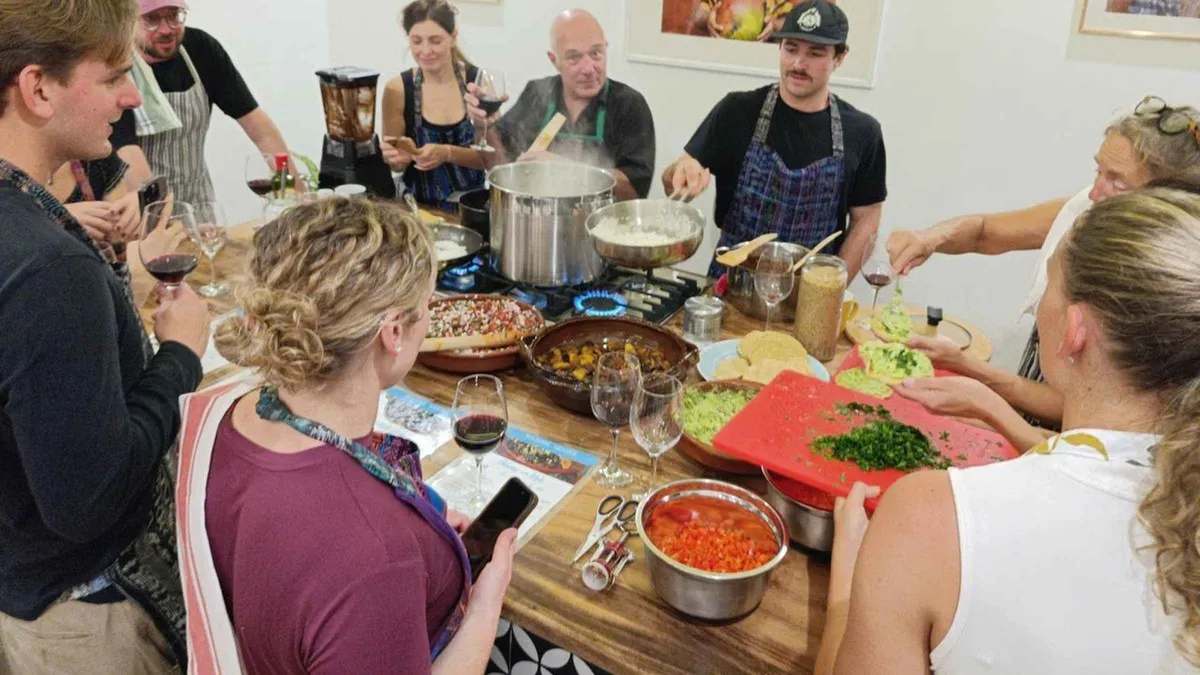 from $38
Antigua Guatemalan Authentic Cooking Class Chef David Farfan
Three hours with Antigua's TV chef cooking pepian and tortillas; market tour optional.
Check Availability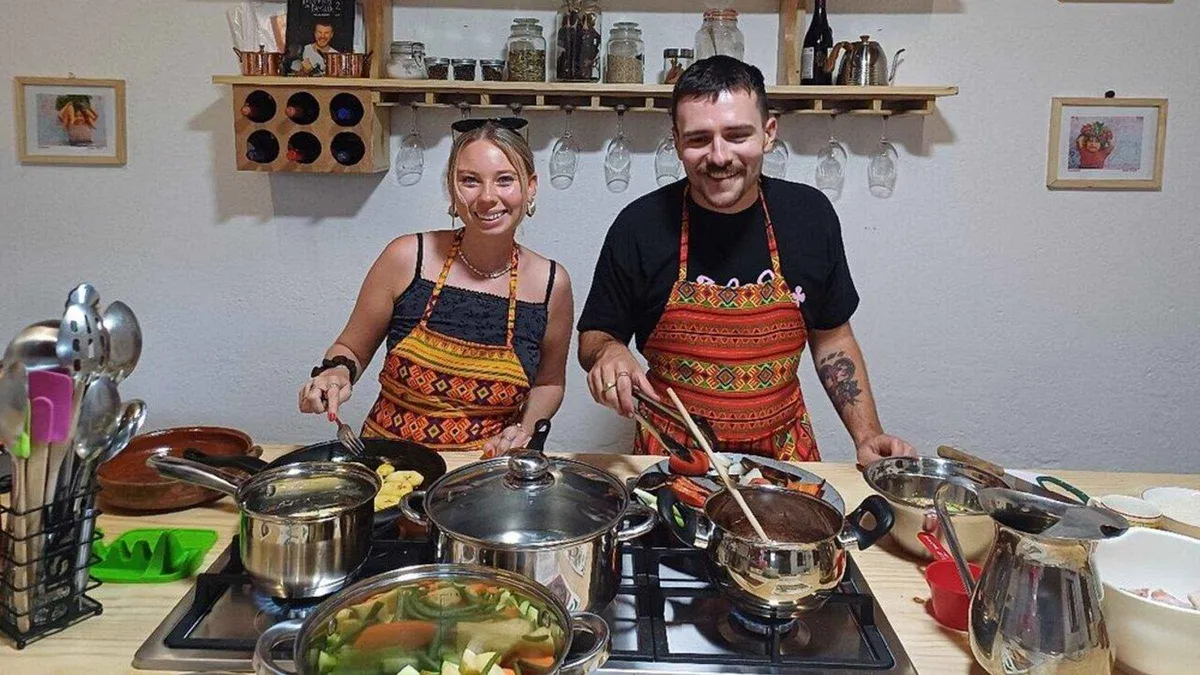 from $38
Antigua: Traditional Guatemalan Cooking Classes — Casa San Miguel.
Two hours of hands-on Guatemalan home cooking in a family kitchen; the private, personal version.
Check AvailabilityPrices, ratings and details are the platform's own. dollar figures are the listed prices — the platform bills in your account's currency.
The Food Map: Three Anchors
Three clusters hold everything on this page: the finca kitchens in Jocotenango, the monastery dining rooms on 3a Calle Oriente, and the centro block where the sweet shops and the plaza sit. Pins come from published addresses and official descriptions. Where a street number is not published, the pin marks the block.
Pins come from published addresses and official descriptions. Where a street number is not published, the pin marks the block.
After The Plate
Walk minutes are our estimates.
Mercado municipal
The market where the comedores live. Produce first, plates where locals eat, and the setting most cooking classes visit before the kitchen.
10-15 min walkBest restaurants
The full cited dining list, rooftop and fine dining included, for the nights when the traditional format is not the answer.
GuideCafes and coffee shops
The cup that ends the meal, and the coffee tours that take you from the plantation to the table.
GuideParque Central
The plaza block where a food walk starts, with ChocoMuseo a street away and the dulcerías in the same grid.
2 min walkWhat To Eat In Antigua Guatemala: Questions
What food is Antigua Guatemala known for?
Pepián, in INGUAT's own wording: a traditional stew full of flavour combining Maya and Spanish influences, the dish the national tourism body names as the city's typical plate. The sweet half of the answer is the dulcerías INGUAT names, led by Doña María Gordillo with recipes since 1872. The full case is in the pepián section.
Is pepián UNESCO-listed?
No UNESCO listing could be verified this check, and the UNESCO database itself was not verifiable on the attempts made, so this page makes no UNESCO claim for pepián or for Guatemalan cuisine. The checkable paper is Guatemala's own SICULTURA registry, which holds 316 declared gastronomy elements. Read the heritage registry section before repeating the UNESCO line.
What is fiambre and when is it eaten?
Fiambre is Guatemala's Day of the Dead plate, served around November 1-2, though no official page we could reach documents it. Treat it as calendar context: a dish tied to the early-November table rather than a restaurant order. The registry context around it is in the heritage section.
Where can I try traditional Guatemalan food in Antigua?
El Maízal, the courtyard Guatemalan kitchen at Finca La Azotea, closes at 16:30 and is closed every Monday. La Azotea Carbón on the same finca runs daily 8am-6pm. For the fine-dining form of the same food, the Casa Santo Domingo rooms El Refectorio and El Tenedor del Cerro under chef Mario Enrique Campollo. The where-to-eat cards carry sources and gaps for each.
Are cooking classes in Antigua Guatemala worth it?
The two cited classes cost $38 each, rated 4.9 from 177 reviews for the Chef Farfán class and 5.0 from 117 reviews for Casa San Miguel. For the price of one restaurant dinner you cook and eat the dishes yourself, usually starting at the market. The side-by-side comparison is in the class cost section.
Is street food in Antigua Guatemala safe to eat?
No official guide publishes a vendor list for this city, so this page prints no names and makes no vendor claims. The safety basics, from water to stalls, live on the safety and scams guide. The cooked-class route is the controlled version of the same food: you watch every ingredient from the market stall to the plate.
Is there a vegetarian guide to Guatemalan food in Antigua?
Not stated anywhere official. No vegetarian or vegan programme exists on any page this guide could cite, and no cited kitchen publishes menu details at all, so the honest answer is that nobody publishes one. Asking in the kitchen is the only tool that works, and a cooking class lets you set the menu yourself: book one on the classes section.
Antigua Guatemala Food On Video
Three food runs that show the plates and the market before you order.
We Tried 14 of Guatemala's Best Foods (Guatemala Food Tour)
Fourteen plates in one run, useful context for pepian and the rest of the guide.
Video: Nicole and MicoThe best traditional food tour in Antigua, Guatemala!
A traditional-food pass through Antigua's kitchens and stalls.
Video: Kerry Gringa in GuatemalaThis Guatemalan Street Food is Unreal! (Antigua & Guatemala City Markets)
Market street food in Antigua and the capital, filmed at the counters.
Video: Max WilfongVideos load from YouTube only when you press play.
Prices, hours and terms are set by the venue or operator and confirmed at checkout.
We may earn a commission if you book through one of our links, at no extra cost to you. Full affiliate disclosure